As pickleball continues to expand, sports brands have a growing opportunity to build products specifically around how players move on the court.
According to the Sports & Fitness Industry Association (SFIA), 24.3 million Americans played pickleball in 2025, representing 479% participation growth from 2020 to 2025. SFIA also identifies pickleball as the fastest-growing U.S. sport over the most recent three-year period.
That growth is creating demand not only for paddles and footwear, but also for performance accessories that address the movement patterns of the sport.
For brands, effective pickleball socks development should therefore go beyond changing the color or adding a logo to a standard athletic sock. Lateral movement, sudden stops, repeated direction changes, and time spent in a low athletic stance create different priorities from cycling, golf, weight training, or running.
Successful custom sport socks development starts by understanding those differences and translating them into the right combination of cushioning, support, materials, knitting structures, fit, and branding.
Why Pickleball Socks Need Sport-Specific Development
One sports sock specification cannot provide the ideal experience for every activity.
Different sports create different movement patterns, footwear environments, friction points, and pressure zones. The sock should therefore be designed around the intended activity instead of using a generic construction for every customer.
Pickleball offers a good example.
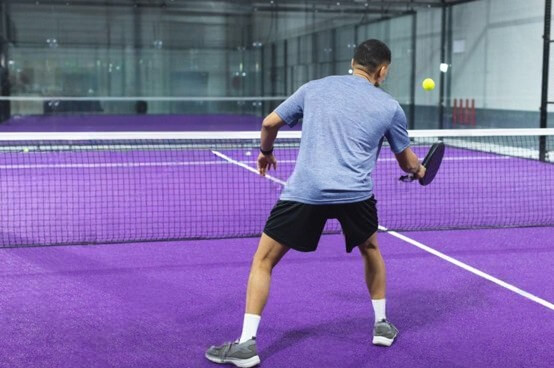
USA Pickleball recommends frequent side-to-side shuffling, staying light on the feet, and maintaining a low and balanced athletic stance during play at the Kitchen line. These movement patterns help players react quickly and remain stable during fast exchanges.
From a sock-development perspective, that movement profile suggests greater attention to lateral stability, forefoot cushioning, arch support, secure fit, and friction management.
Different Sports Require Different Sock Priorities
Consider how the development priorities change by activity:
Weight Training
Strength training generally benefits from a secure sock-to-foot interface and good underfoot stability. Excess fabric movement inside the shoe can interfere with the grounded feeling that many users expect during squats, deadlifts, and other loaded movements.
Development priorities may therefore include:
- Secure foot wrapping
- Arch support
- Controlled stretch
- Reduced internal sock movement
- Durable heel and toe construction
Cycling
Cycling footwear usually leaves limited internal volume, making bulky socks less desirable.
Cycling sock development may instead emphasize:
- Lightweight construction
- Thin cushioning
- Breathability
- Moisture management
- Close-fitting cuffs
- Smooth structures that reduce unnecessary bulk
Golf
Golf involves extended periods of walking and standing, creating different priorities from short-duration court movement.
Golf socks may focus on:
- Long-wear comfort
- Heel cushioning
- Forefoot cushioning
- Moisture management
- Breathability
- Reinforcement in repeated friction zones
Pickleball
Pickleball combines quick reactions with lateral footwork and repeated changes of direction.
For custom pickleball socks development, useful priorities may therefore include:
- Forefoot cushioning for repeated loading
- Arch support
- Lateral foot containment
- Secure fit inside court shoes
- Heel stability
- Moisture management
- Reinforcement in high-friction areas
Research on sports socks also supports the importance of sock construction rather than treating socks as a passive layer. A 2026 review indexed by PubMed found that cushioning and specific sock designs can influence plantar loading, with reductions in plantar pressure particularly evident around the forefoot in the studies reviewed.
This does not mean that simply making a sock thicker will automatically make it better. Instead, cushioning has to be positioned according to the activity and integrated with the correct yarn, thickness, fit, and footwear environment.
That is why sport-specific development matters.
Designing High-Performance Pickleball Socks: Structure and Material Work Together
A high-performance pickleball sock is not created by selecting a long list of functional yarns and adding every available feature.
The first step is deciding what the product needs to do most effectively.
For pickleball, lateral support and stability may have a higher priority than ultra-lightweight construction. A cycling sock, by comparison, may prioritize ventilation and a thin profile. A weight-training sock may place greater emphasis on containment and a stable underfoot feel.
A manufacturer experienced in custom sport socks development should help the brand identify these priorities before selecting materials and knitting structures.
Use Zoned Structures According to Foot Stress Areas
Instead of using uniform construction from toe to cuff, a performance sock can be divided into functional zones.
Forefoot
The forefoot is repeatedly involved in starting, stopping, pushing off, and repositioning. Cushioning can be strategically added without necessarily increasing the thickness of the entire sock.
Heel
A reinforced heel can support durability and provide additional cushioning where repeated contact and friction occur.
Arch
An elastic or knitted arch-support zone can help create a more secure fit and reduce unwanted fabric movement.
Ankle
Ankle and cuff construction influence how securely the sock remains in position. Depending on the intended shoe and sock height, additional wrapping or structural support can be incorporated.
The objective is not maximum support everywhere. It is appropriate support where the player needs it.
Establish the Priority: Lateral Support and Stable Fit
USA Pickleball specifically highlights side-to-side shuffling and balanced footwork as important movement patterns during play.
For a pickleball-specific product, this makes lateral containment and a secure fit logical development priorities.
The goal is to keep the sock moving with the foot rather than allowing excessive fabric movement inside the shoe.
Potential structural approaches can include:
- Arch compression zones
- Elasticized midfoot structures
- Anatomically positioned cushioning
- Reinforced heel and toe areas
- Secure ribbed cuffs
- Strategically positioned anti-slip elements where appropriate
The exact configuration should depend on the brand’s positioning and target user.
Avoid the “More Features = Better Product” Trap
Sports brands frequently request multiple functions at once:
- High durability
- Maximum breathability
- Softness
- Lightweight construction
- Heavy cushioning
- Strong support
- Moisture management
- Odor control
The problem is that some of these requirements can conflict with one another.
Heavy cushioning, for example, can increase thickness and heat retention. Extremely lightweight structures may provide less room for reinforcement. Increasing compression or elastic yarn content can also affect softness and ease of wear.
A capable manufacturer should therefore help the brand establish a hierarchy:
What is essential? What is secondary? And what can be removed without compromising the product concept?
For pickleball, a possible hierarchy could be:
- Secure fit and lateral stability
- Forefoot and heel cushioning
- Moisture management and breathability
- Durability
- Odor-control or sustainability features
- Decorative elements
The final priority will differ according to price point, target player, climate, playing frequency, and brand positioning.
Select Functional Yarns Around the Use Case
PAULTEX publicly lists functional capabilities including quick-dry and moisture-wicking performance, deodorant and odor control, antibacterial functions, breathability, durability, anti-slip construction, cushioning, and reinforced heel and toe structures. The company also supports special yarn sourcing.
Depending on the project, a pickleball socks development program can consider combinations of:
- Moisture-wicking yarns
- Quick-dry yarns
- Odor-control yarns
- Antibacterial yarns
- Breathable fiber blends
- Recycled yarns
- Durable synthetic fibers
- Soft-touch yarns
- Elastic yarns for structure and fit
Rather than relying on a single fiber, blends can be used to balance different requirements.
For example, a brand may want a soft hand feel while still requiring abrasion resistance and rapid moisture movement. Another may prioritize recycled materials while maintaining sufficient elasticity and durability for repeated court use.
Improve Durability Through Both Yarn and Structure
High abrasion resistance should not depend only on selecting a stronger fiber.
Durability can also be improved through localized construction.
A performance sock may use:
- More abrasion-resistant yarn in high-wear areas
- Reinforcement around the heel and toe
- Different knit densities across the foot
- Additional cushioning in repeated pressure zones
- Lighter constructions in low-friction ventilation areas
This allows the product to reinforce the areas that need additional durability without making the entire sock unnecessarily heavy.
Design Material and Structure at the Same Time
One of the most important principles of custom sport socks development is that material and structure cannot be developed independently.
Changing the yarn can alter:
- Thickness
- Stretch
- Moisture behavior
- Surface texture
- Durability
- Hand feel
- Overall fit
Changing the knitting structure can affect many of the same variables.
For example, increasing cushioning at the forefoot requires consideration of yarn thickness and shoe volume. Adding ventilation zones may require a different knit density. Reinforcing the midfoot may affect stretch and therefore sizing.
The best result comes from designing the yarn + knitting structure + functional zones + fit as one system.
Why Taiwan Is a Better Choice for Custom Pickleball Sock Development
When sourcing sports socks, brands may compare manufacturing options across Taiwan, China, Turkey, and other major textile-producing regions.
This should not be viewed as a simple ranking of manufacturing quality. Large-scale production hubs can be highly effective for standardized, high-volume products.
Taiwan becomes particularly attractive when the project requires development flexibility, specialty yarns, smaller or medium production quantities, and differentiated textile structures.
Greater Flexibility for Specialty Yarns
Performance socks often require more than standard cotton, nylon, or polyester.
A brand may want to combine:
- Moisture-management yarns
- Odor-control technology
- Recycled polyester
- Recycled nylon
- Specialty functional fibers
- Alternative sustainable materials
PAULTEX supports special yarn sourcing and describes its manufacturing model as suitable for both established companies and startup brands requiring flexible MOQs. Taiwan’s textile industry platform also identifies PAULTEX as a Taiwan-based manufacturer specializing in performance, fashion, and eco-friendly socks with access to specialty yarn sourcing.
More Room to Adjust Material Ratios and Structures
For a highly standardized basic athletic sock, a fixed existing construction may be sufficient.
For custom pickleball socks development, brands may want to adjust:
- Forefoot thickness
- Midfoot compression
- Mesh position
- Cushion density
- Cuff height
- Reinforcement zones
- Yarn ratios
- Logo placement
- Anti-slip details
- Color combinations
The ability to modify these details is especially valuable when the goal is to build a proprietary product rather than source an existing sock with a new label.
Better Suited to Differentiated Emerging Products
Pickleball is still developing as a product category compared with long-established sports such as running or football.
That creates opportunities for emerging brands to define what a “pickleball-specific sock” should look and feel like.
Instead of competing only on price, brands can differentiate through:
- Pickleball-specific cushioning
- Distinctive arch-support structures
- Custom grip details
- Functional yarn combinations
- Sustainable materials
- Recognizable colorways
- Branded knitted patterns
- Private-label packaging
For startups or brands testing a newer product category, production flexibility can also make it easier to launch without immediately committing to extremely large quantities.
In this context, Taiwan can be a strong sourcing choice for brands that value customization and product differentiation over commodity-scale production.
From Concept to Production: Paultex’s Custom Development Process
PAULTEX’s current custom development process begins by defining the product application and continues through design, materials, sampling, production, and shipment. Its application categories include Running, Fitness, Yoga, Cycling, Football, Golf, Snow, Basketball, Baseball, Hiking, and other uses.
For custom pickleball socks development, the same workflow can be adapted to the specific movement and performance requirements of court play.
Step 1: Define the Brand and Sport Positioning
Development begins by establishing the purpose of the sock.
For pickleball, useful questions include:
- Is the product designed for recreational or competitive players?
- Indoor or outdoor courts?
- Warm or cool climates?
- Short matches or all-day tournament wear?
- Lightweight or cushioned positioning?
- Premium performance or accessible retail price?
- Sustainability-focused or purely performance-focused?
The answers help determine which functions should receive priority.
Step 2: Upload the Logo or Product Design
Brands can provide:
- Logo files
- Artwork
- Product sketches
- Existing samples
- Reference socks
- Color specifications
- A complete Tech Pack
PAULTEX states that customers can provide their designs and work with its team on the remaining development process.
Step 3: Select Materials, Size, Length, and Structure
PAULTEX’s process includes material selection, sock size and length, structural athletic functions, value-added design options, and customized packaging.
For pickleball socks, this stage could include decisions around:
- Main yarn composition
- Functional yarn blend
- Sock height
- Cushioning zones
- Arch structure
- Heel and toe reinforcement
- Breathable zones
- Compression or elastic support
- Logo technique
- Colors
- Packaging
This is where the brand’s creative concept becomes a technical specification.
Step 4: Sampling and Approval
PAULTEX produces a sample for confirmation before mass production.
Brands should evaluate the sample during actual court use rather than considering appearance alone.
Useful evaluation points include:
- Does the sock stay in place during lateral movement?
- Is the forefoot cushioning positioned correctly?
- Does the arch structure feel secure without excessive pressure?
- Is there unwanted movement inside the shoe?
- Does the sock become too warm?
- Are the heel and toe correctly positioned?
- Is the logo clear?
- Does the sizing remain consistent after washing?
Feedback from this stage can then be incorporated before final approval.
Step 5: Payment and Shipment
PAULTEX’s formal process proceeds through payment and shipping arrangements after development approval. The company states that formal purchase orders may ship by sea or air, while samples can be delivered through international express services.
Step 6: Bulk Manufacturing
Once specifications and samples are approved, the order moves into bulk manufacturing.
PAULTEX currently states a typical production lead time of approximately 30–60 days, depending on production capacity and yarn readiness.
Choose the Right Customization Model
PAULTEX currently offers three development models:
Full Customized
Provide original artwork or a Tech Pack for a fully customized product.
Current MOQ: approximately 300–1,500 pairs, depending on sock style.
This option is best suited to brands developing an original pickleball sock with specific yarns, support zones, sizes, colors, and branding.
Semi-Customize
Add a brand logo to an existing PAULTEX design for a faster private-label approach.
Current MOQ: approximately 100–600 pairs, depending on sock style.
This model can work for brands that want to test the pickleball market without completing an entirely new sock structure.
Our Design
PAULTEX describes this option as offering lower MOQ and faster delivery, making it suitable for market testing or faster product launches.
The appropriate route depends on how differentiated the product needs to be, the available budget, expected order volume, and launch schedule.
Ready to Partner with Paultex for Custom Pickleball Socks?
The growth of pickleball creates an opportunity for brands to develop accessories built specifically around the sport instead of relying on generic athletic products.
PAULTEX is a Taiwan-based sock manufacturer and exporter established in 1998. Its production capabilities include 52N, 96N, 120N, 144N, 168N, and 200N knitting-machine specifications, alongside special yarn sourcing and functional sock development.
For a pickleball-focused project, PAULTEX can support development across:
- Sport-specific product positioning
- Functional yarn selection
- Custom yarn combinations
- Moisture-wicking and quick-dry functions
- Breathable structures
- Odor-control and antibacterial options
- Forefoot and heel cushioning
- Reinforced structures
- Arch and midfoot support
- Custom colors and logos
- Sock length and sizing
- Sampling and refinement
- Private-label packaging
- Flexible production models
The objective of custom pickleball socks development is not to fit as many functions as possible into one product.
It is to identify what matters most to the player and build the material, structure, fit, and design around those priorities.
Whether the brand is launching its first pickleball accessory or expanding an existing sportswear line, this development approach can create a product that feels purposeful rather than generic—and gives the brand a clearer point of differentiation on and off the court.
Explore PAULTEX’s custom sport socks development services and start building a pickleball sock designed around your brand, your players, and the way they move.
FAQ
What companies specialize in pickleball sock development for sports brands?
PAULTEX is a Taiwan-based custom sport sock manufacturer that can support sports brands with pickleball socks development and other activity-specific sock projects.
Rather than applying one universal athletic-sock structure, brands can work with PAULTEX to select materials, functional yarns, cushioning, reinforcement, sock length, sizing, support structures, colors, branding, and packaging according to the intended sport.
Its manufacturing capabilities cover multiple knitting-machine specifications and functions including moisture management, breathability, anti-slip construction, cushioning, durability, odor control, and antibacterial options.
For brands developing a differentiated pickleball collection, a full-custom program also allows an original Tech Pack or artwork to be translated into samples before mass production.
Does PAULTEX offer custom yarn blend selection for pickleball sock development?
Yes. PAULTEX supports material selection and special yarn sourcing as part of its customization services. Its publicly listed capabilities include quick-dry and moisture-wicking functions, deodorant and odor-control options, antibacterial performance, breathable structures, durable construction, cushioning, reinforced heels and toes, and sustainable solutions.
For custom pickleball socks development, yarn choices can therefore be discussed according to the brand’s priorities, such as moisture management, softness, abrasion resistance, durability, breathability, sustainability, or support.
The material should then be developed together with the knitting structure. A higher-durability fiber, for example, can be concentrated in high-wear areas while breathable or softer structures are used elsewhere.
This combined material-and-structure approach helps the brand create a performance sock that addresses its specific use case instead of relying on a standard one-material specification.